Thursday, February 8, 2018

The People vs. Alcoholic Beverage Wholesalers: Why It’s Getting Harder to Ship Alcohol Across State Lines


            Granholm only took us so far.  In 2015, UPS and FedEx announced they would no longer accept shipments of alcoholic beverages from retailers if the goods were not bound for one of fourteen states that explicitly allows such exchange in response to a crackdown by state regulators.[1]  This is a sharp departure from prior practice. 
            Before 2015, state laws requiring a license to ship across state lines were technically on the books.  But they went unenforced, and their interpretation was up for debate.  Retailers shipped alcohol much more freely over state lines, creating enormous opportunities for alcoholic beverage retailers to expand their customer base considerably by fulfilling out-of-state orders over the internet.  This was good for consumers, too.  A family hosting a dinner party in rural Missouri who wanted to serve Walla Walla Riesling could order a few bottles directly from a Seattle retailer, paying the cost of shipping for the privilege.
However, a coalition of alcoholic beverage wholesalers, led by Wine and Spirits Wholesalers of America (WSWA), has been systematically lobbying states and the federal government to favorably interpret these statutes and enforce them against interstate alcoholic beverage shippers.[2]  
WSWA is a formidable foe.  The industry group has nearly 400 member companies, representing 80% of the wholesale market.  It enjoys tax-favored 501(c)(6) nonprofit trade association status.[3] 
Daniel Posner, owner of a White Plains wine retailer and President of the National Association of Wine Retailers discussed the fracturing effect on the retail sector, allowing wholesalers to further consolidate their industry power.[4] 
Craig Wolf, President and C.E.O. of WSWA, defended the industry group’s motivations, citing their interest in consumer protection.  Mr. Wolf insisted the tighter regulations would reduce counterfeiting and curtail underage drinking by teens ordering alcohol over the internet.[5]  Mr. Posner countered, telling the New York Times that “this is pure greed.”[6] 
Regardless of whether there is a legitimate health and safety concern associated with allowing retailers to ship their wares across state lines, state regulators are not doing their constituents any favors.  They are protecting out-of-state interests at the expense of retailers back home, and distorting the alcoholic beverage market in the process.  This is not effective governing.  Sit down, state representatives, you’re drunk. 


[1] Eric Asimov, Wines are no longer free to travel across state lines, The New York Times, Oct. 23, 2017, https://www.nytimes.com/2017/10/23/dining/drinks/interstate-wine-sales-shipping-laws.html?_r=0.
[2] Id.
[3] Wine and Spirits Wholesalers of America Website, www.wswa.org.
[4] Asimov, supra n. 1.
[5] Asimov, supra n. 1.
[6] Asimov, supra n. 1.

Tuesday, February 6, 2018

An Anti-Aging Wine

Conventional wisdom is that wine gets better as it ages. Rob Newell's blog post does a good job explaining that this is mostly untrue – 99% of wine is intended to be consumed within five years of production. However, I was curious if there were any outliers that were meant to be consumed very soon after production, and stumbled upon Beaujolais nouveau as just such a wine.

While perhaps unsurprising to those who know wine, I discovered that Beaujolais has a unique production process and sales strategy. In terms of production, it is only aged for a few weeks, being bottled just 6-8 weeks after the harvest. The grapes and the production process lend to a unique flavor that is very fruity and sweet. The wine is known not to improve with age, but rather to be consumed shortly after purchase. Adding to its idiosyncrasies, the red wine is also meant to be consumed chilled.

While many love Beaujolais, some consider it a simple and unsophisticated wine. Its sales have fluctuated over the last few decades, with some asking whether it will make a comeback (http://www.bbc.com/news/blogs-magazine-monitor-30079340), but others saying that the peaks in demand are due to hipster trends.

The most interesting aspect of Beaujolais nouveau, however, is how it is sold: once per year, at midnight on the date of a specific night in November. Unlike any other wine (that I could identify), the entire vintage is released all at once. This mass release, along with some heavy marketing, creates a rush and celebration surrounding buying and consuming the wine that is well known throughout the wine community, and has come to define the wine.

All of this leaves me to wonder: in a retail climate in which "experience-driven purchases" are increasingly common, can other wine labels and regions create a similar experience? Tastings are one way in which vineyards already do this, but is there a way to do it on a larger scale and inclusive of an entire region?

Monday, February 5, 2018

"Wine. Since 6,000 B.C."

I was hired to join the startup I was at before the GSB because I won a pun contest.  To say that I love catchy marketing, clever copy, and creative imagery is an understatement.  Like many in the class, I found Terry's presentation very compelling.  In many ways, she has my dream job!

I started thinking about catchy wine marketing, and thought immediately of the Michelob Ultra beer ad that I had recently seen.  While it's, well, the opposite of a promotion for drinking wine, I started to wonder if wine marketers had taken similar jabs at beer drinkers too.


My search came up with fewer popular ads, and the ones that did jump out were ones that took a less obvious jab at beer. A particularly interesting approach was in highlighting wine as an age-old choice. The tagline?  "Wine. Since 6,000 B.C." I'd love to hear Terry's take on this one!

Branding and Perceived Quality

In one of my classes this week, the professor ran a very interesting experiment. We had a blind tasting of 3 cups of vodka - two from the same brand, and the third from a different one. The two brands poured are Smirnoff and Absolut, but we don't know which brand is poured into two cups instead of one. The experiment was conducted in a double-blinded way (i.e., the professor didn't know the right answer till the experiment is done), and the question for us was to identify which cups are from which brand.

Before the experiment, many of us were quite confident that Absolut "tastes better" and is "smoother" than Smirnoff (myself included). As a matter of fact, Absolut's retail price is about 50% more than that of Smirnoff. However, when the class started tasting, we very much disagreed with each other on our perception of the results. In the end, only one student out of 15 gave the correct answer (expected value of a correct random guess is 1/8 - we did worse than guessing randomly).

The purpose of the experiment was to show us the power of branding and consumer perception. That made me reflect on the wine market as well - how does branding affect our perception of the quality of the wine? Obviously, it's easy to tell the difference between a $5 bottle and a $100 one, but how do consumers differentiate the difference between a) a $100 bottle and a $500 bottle, and b) a $7 bottle and a $10 bottle?

It's interesting to further reflect on the concept of branding in wine. What does it exactly mean? We learned about 5 ways of brand association in class: Sincerity, Excitement, Competence, Sophistication, and Ruggedness.

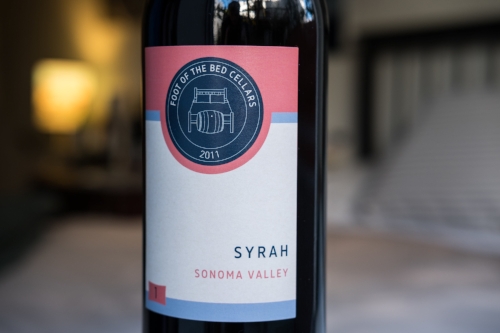
- Sincerity: to be "sincere" in wine probably most closely means to be honest. Label the wines in a consumer-friendly way, and call it what it is. I think the Foot of the Bed Cellars that the Wine Circle introduced to us in a tasting event is a good example of it - unassuming design and super easy to read labels.

- Excitement: this has much to do with the design and labeling of the bottle. A quite effective way to introduce excitement is through complete subversion of the traditional image of wine: to turn the elegant, exclusive, mature image of wine into a unvarnished, embracing, and young one. The success of Apothic wines could be a good example of using excitement to capture the younger drinkers.

- Competence: winemakers can also achieve brand recognition through proven competence. I think Kirkland Signature can be a "pure play" competence brand: consumers really don't get any utilities from its brand except for knowing that it is a drinkable wine at a very affordable price.

- Sophistication: this is likely the most widely used strategy in wine branding, from the Burgundy 1er Crus to the $100+ bottles in Napa. When consumers purchase a sophisticated brand, they experience two levels of enjoyment: one from the self-realization of their capability to appreciate sophistication, and one from the expected recognition from others of the consumer's status. Drinking a bottle of Opus One is not that different from wearing an Hermes.

- Ruggedness: this could be an interesting one... Surprisingly, winemakers can associate their bottles with ruggedness yet drinkable. Consider 19 Crimes - it sells wine through association with the earliest prisoners sent to Australia from the UK. The image of untamed, brave explorers of the new world strangely speaks to wine drinkers - maybe it's in wine where people are searching for their alter ego.

Foot of the Bed Cellars - Sonoma Valley Syrah:
Image result for foot of the bed cellars

Apothic wines:
Image result for apothic wine

Kirkland Signature
Image result for kirkland signature wine

Petrus, retails at $3,500+
Image result for petrus


19 Crimes:
Image result for 19 crimes

Sunday, February 4, 2018

"Peeno Noir"

Terry's presentation in class surprised me - I had completely underestimated the marketing capability of creative, pop culture wine labels. I knew that wine labels could be powerful. As Terry said, walking down the aisle of a store you typically spend only 30 seconds glancing at hundreds of bottles so a powerful label is crucial to drawing the consumer's attention. Yet, in my own experience, I quickly ignored the more modern labels that have creative/witty names or references to pop culture and celebrities. I always associated those labels with poor quality. I assumed that there would be a substantial mark-up for the creative label and I would be paying more for that than quality. (At least with big name vineyards you are paying for a brand name associated with quality.) But, after researching more, I've learned that, among millennials, I hold a minority viewpoint. As it turns out, there are more quirky names out there than I had imagined - and many of them have had a lasting presence on the shelves.(1) For example, the wine label "Seven Deadly Zins" has been successful because the pun is memorable.(1) Some consumers could be more likely to remember that witty name than the name of a vineyard. Wine labeling even fits with millennial trends in gift giving. Since millennials have shown they like to give more personalized gifts, they are more likely to buy a label that has some relevance to them or the person they are gifting the wine to. Personally, I have received as gifts about a half dozen bottles of "Peeno Noir", a label referring to a character in the TV show Unbreakable Kimmy Schmidt.(2) The friends who have gifted me this certainly did not pick that bottle for its quality but instead because it referred to something related to me (I really like the show). While I don't plan on changing my own buying habits in the near future, Terry's presentation opened my eyes to the huge market opportunity for labeling wines targeted at the millennial consumer.

Sources
(1) http://digitalcommons.calpoly.edu/cgi/viewcontent.cgi?article=1072&context=grcsp
(2) https://munchies.vice.com/en_us/article/wnbza9/tituss-burgess-of-unbreakable-kimmy-schmidt-doesnt-suffer-wine-snobs

Friday, February 2, 2018

Traditional customer segmentation still works...sometimes

In my last job, I spent a lot of time thinking about how traditional customer segmentation was an unsophisticated, dated way to think about markets. Just for clarity, I am defining a "traditional" customer segmentation as a way of dividing up customers by certain (usually) observable characteristics. Think: ages, gender, income level, political party affiliation, dietary restrictions, etc.

The "correct" way I learned to view market segmentation was through needs. That is, you should figure out what needs drive customer purchasing behaviors, and then determine how to cater to / reach these different need groups. As a simple example, say you had 3 customers: an old man, a young woman, and an old woman. If you had to form 2 groups with these characteristics, you might decide either of the 2 options:

  • Old man and old woman | young woman
  • Old woman and young woman | old man
Imagine that you're a hotel company: how useful would it be to define a brand based on age? Wouldn't it be more useful to know what the customers wanted from a hotel stay?

Under the alternative approach, I would try to understand the needs of these different customers first. In this example, the old man and the young woman are both planning a tropical beach vacation while the old woman is planning a cultural trip to a large city. Now, it's much easier for a hotel company to target a specific group of consumers: those with a specific need. But, without understanding the market needs, you may not have naturally grouped some of these customers together.

This approach makes a ton of sense in practice: think about the application to air travel (business trip versus leisure trip regardless of personal income), restaurants (night out with the kids versus night out with friends), etc. And, while it's still helpful to characterize the customers within / between these need groups (can help with marketing if certain attributes stand out), it becomes a dependent variable.

So how does this relate to wine?

Terry's presentation opened my eyes to the fact that wine marketing is effectively based on traditional segmentation. Yes, certain, distinct needs exist in the wine market, but given the unbelievable variety of products that exist to fulfill almost every need (think about the abundance of wine at different price points / different taste profiles / different "prestige" levels), traditional segmentation is perhaps a significantly more effective exercise than a needs-based approach. 

Terry segmented the market based on observable characteristics: cowboys, middle sisters, loners... and then made the product appeal to the emotions of those segmented groups. The dependent variable here was the needs of the different groups (e.g. what taste profile the wine was designed to reach).

So maybe, traditional segmentation is still alive and well, under certain market conditions. It's something I'll consider more in the future.


Judging a Wine By Its Bottle

Yesterday I was struck by the statistics that Terry offered about the importance of packaging. Namely,

  • 64% of people will try a new product because packaging catches their eye
  • 41% will continue to purchase a product because they like the package

In fact, I actually hypothesize that these statistics are likely higher for wine (although after a bit of searching, I was unable to find the data to support this).

According to Nielsen, last year 14% of all items in the wine category were new products. While that actually may not seem like a huge percentage of the category, that translates into roughly 3,500 new items. Although after hearing Terry rattle off idea after idea for new wine brands, I'm surprised this number isn't higher. Nevertheless, the importance of winning the consumer purchase decision in what are often incredibly competitive spaces (that grocery store wine aisle is no joke, am I right?), it seems obvious that brands must leverage every tool they can to more effectively market their product.

As we learned earlier, due to tied-house laws, it can be particularly tricky for alcohol brands to advertise their wines, especially on social media. Additionally, I was curious to learn that wine brands' marketing spend is just 8% of that of beer brands - although unsurprising given the overwhelming number of beer ads I see on TV and the notable absence of wine ads. All this to say, wine brands rely heavily on the advertising that happens at the time of the purchase decision - on the shelf.

Back to Nielsen stats again. According to a recent study, only 29% of consumers know which wine brand they plan to buy before entering the store. That means that a whopping 71% of consumers are making their decision standing in the aisle, and packaging is the most effective tool brands can use to win that purchase.

Thus, it seems natural that wine brands would invest heavily in the design process and look to the market for feedback on a variety of options, right? Wrong. According to a survey of FMCG (fast-moving consumer goods) executives about their company's design process, 75% responded that important design decisions are made subjectively - by group consensus (33%), qualitative focus groups (55%), or by the opinion of a senior executive (53%). I was surprised listening to Terry's explanation of her own brand building process how little she mentioned about looking to end-consumers for feedback. It wasn't until the very end of the discussion that we heard about the Wine Sisterhood social media platform that can be leveraged for such informal consumer research, but all throughout I was wondering why this primary research didn't play a more formal role in the design process? It seems like a huge missed opportunity. But then I wonder, what is the life of each of these new brands anyway? (Again, I tried and failed to find any stats on this). Perhaps it doesn't make sense to invest the resources if the brand is only going to be around for 1-2 years. Plus, it doesn't seem that hard to come up with ideas for new brands (again, I refer back to Terry's long list of ideas), so maybe it makes sense after all to throw everything at the wall and see what sticks.

Source: http://www.nielsen.com/us/en/insights/news/2017/how-package-design-attracts-todays-wine-consumer.html